
For childless couples and singles in Queensland, estate planning isn’t something to put off until later; it’s the one decision that can determine exactly who benefits from everything you’ve worked for. Without children to inherit by default, the question of where your estate goes becomes more complicated, and leaving it unplanned could mean that the government, not you, decides the outcome.
Why Estate Planning Still Matters Without Children
Many people think of estate planning as something parents do: name guardians, divide assets among the kids, and call it a day. But when there are no children in the picture, the process becomes even more personal. It’s about deciding who and what truly matters to you, and how to protect those choices legally.
Australia’s family landscape is changing. The 2021 Census showed there were around 2.6 million couple families without children (ABS), representing 39% of the 6.73 million Australian families (AIFS). Add to that the growing number of single adults, and it’s clear that a significant share of Australians are navigating estate planning without the traditional motivator of parenthood.
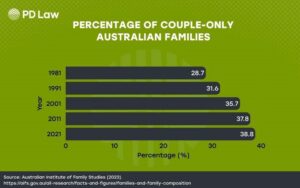
Census data from 1981 to 2021 reveal a clear shift in Australia’s family landscape: more couples are living child-free, by choice or circumstance.
Yet despite this demographic shift, most Australians still don’t have a Will. A 2022 Finder survey found that roughly 60% of Australians, or around 12 million people, have no valid Will. For those without children, that lack of planning leaves an even bigger gap. Without a Will, your estate doesn’t automatically go to the people or causes that matter most to you.
What Happens in Queensland If You Die Without a Will
In Queensland, dying without a valid Will is called dying intestate. When that happens, your estate is distributed under the Succession Act 1981 (Qld), not according to your wishes but by a strict legal formula.
If you’re part of a childless couple, intestacy means your spouse or de facto partner will inherit your entire estate. That might sound fine at first, but consider what happens if your partner also dies without a Will. The estate then passes to parents, then siblings, then increasingly distant relatives, all following a hierarchy that may have little to do with the people you actually care about.
For single person without children, the law is even less personal. Without a Will, your estate usually goes to your parents, then siblings, and so on. If there are no living relatives, everything you own — your home, savings, super, and personal items — passes to the Queensland Government under the doctrine of bona vacantia. It’s a sobering thought: a lifetime of work could end up in the government’s hands simply because no document said otherwise.
The Unique Estate Planning Challenges for Childless Couples
Childless couples face a few added layers of decision-making. Estate planning isn’t just about distributing assets; it’s about ensuring your partner and future wishes are protected in every scenario.
Who Makes Decisions If You Can’t?
If you lose capacity because of illness, injury, or simply age, someone must step in to handle financial and personal matters on your behalf.
For childless couples, the partner is often the first choice. But life isn’t always predictable. What if both of you are affected, or your partner is unavailable when decisions need to be made?
In Queensland, an Enduring Power of Attorney (EPOA) under the Powers of Attorney Act 1998 (Qld) allows you to appoint one or more trusted people to make decisions when you can’t.
You might also consider naming a “nominated person” under your EPOA— someone who isn’t making decisions but is kept informed. Their role is to stay across what your attorney is doing, providing valuable oversight and ensuring your directions are followed. They can request updates, raise concerns, and, if necessary, apply to the Queensland Civil and Administrative Tribunal (QCAT) to review an attorney’s actions.
Taking this extra step builds accountability into your planning. It helps ensure that, if you lose capacity, your affairs are managed exactly as you intended — transparently, responsibly, and with the right checks and balances in place.
Without an EPOA, loved ones may have to apply to the QCAT for authority, a process that’s time-consuming, stressful, and expensive.
Superannuation Doesn’t Automatically Go to Your Partner
Many people assume their superannuation automatically goes to their partner, but that’s not the case. Superannuation sits outside your estate and is managed separately by your fund’s trustee. To ensure it goes to the right person, you need a Binding Death Benefit Nomination (BDBN). Without it, the trustee decides who receives the funds. Most funds will consider your partner, but there’s no guarantee — and many nominations expire after three years.
Choosing Beneficiaries Requires Real Thought
For parents, beneficiaries are obvious. For couples without children, the question opens wide. Who do you want to benefit — your partner, siblings, friends, or perhaps a charity close to your heart? A well-drafted Will lets you make those choices clearly. You can even decide what happens if your partner dies before you, ensuring your estate doesn’t automatically follow the intestacy rules.
Estate Planning for Singles Without Children
For single adults, the stakes are just as high. Without a partner or children, there’s no default next of kin who automatically steps in. The Succession Act’s hierarchy takes over, regardless of personal closeness.
Let’s take, for example, a professional in Cannonvale who is single and has built a strong circle of friends but is estranged from family. Under intestacy, those friends receive nothing, while distant relatives could inherit everything.
A complete estate plan for singles should include:
- A valid Will naming specific beneficiaries — family, friends, or charities — and substitute beneficiaries in case someone predeceases you.
- An Enduring Power of Attorney, appointing someone trustworthy to manage your affairs if you lose capacity.
- An Advance Health Directive, setting out your medical treatment preferences if you can’t communicate them.
Together, these documents ensure your wishes are clear and legally enforceable, sparing friends and loved ones unnecessary stress.
Leaving a Legacy Through Charitable Giving
Without children as primary heirs, many people choose to create a legacy through charitable giving. In Queensland, you can leave:
- A specific bequest (a set amount or asset);
- A residuary bequest (a portion of what remains after other gifts);
- Or a charitable trust, which continues giving long after you’re gone.
These options allow you to support causes that reflect your values — education, animal welfare, environmental protection, or local community organisations. The key is to have your Will drafted professionally so your intentions are legally sound and adaptable if a charity ceases to exist.
De Facto Relationships: Know Where You Stand
Queensland law recognises de facto partners under the Succession Act 1981 and Property Law Act 1974, but only under certain conditions. Generally:
- a de facto relationship must have existed for at least two years, or
- one partner must have made substantial contributions to the other’s property or welfare.
If your relationship doesn’t meet those thresholds and your partner dies without a Will, you may have no automatic right to inherit. Even if you qualify, proving the relationship can be stressful and expensive. A valid Will removes this uncertainty — it’s a clear statement of intent that ensures your partner is protected.
When to Review Your Estate Plan
Life changes, and your estate plan should change with it. Key moments to review your documents include:
- Marriage or entering a de facto relationship (marriage automatically revokes a prior will unless made in contemplation of marriage)
- Separation or divorce
- Buying or selling property
- Receiving an inheritance
- The death of a named executor, attorney, or beneficiary
As a general guide, revisit your estate plan every two to three years — or earlier if significant changes occur in your life, relationships, or assets. It ensures your documents stay relevant and your intentions remain clear.
To learn more about the importance of updating a Will, read our article here.
The Real Cost of Doing Nothing
It’s easy to put off estate planning, especially when you don’t have children reminding you to “get your affairs in order.” But the cost of inaction can be steep. Without a Will, the Queensland Public Trustee steps in to administer your estate, and that process involves fees. Family disputes can drain funds and goodwill alike. And assets can end up with people you would never have chosen.
Here to Help You Protect Your Legacy
Whether you’re a childless couple building a life together or a single professional creating something meaningful, your estate deserves a plan that reflects your intentions.
The process doesn’t have to be confusing. A conversation with one of our experienced Estate Planning Lawyers can help give you peace of mind and clarity.
At PD Law, we help individuals and couples — at every stage of life —protect their wishes and their legacy.
Talk to one of our seasoned Cannonvale Lawyers today.